
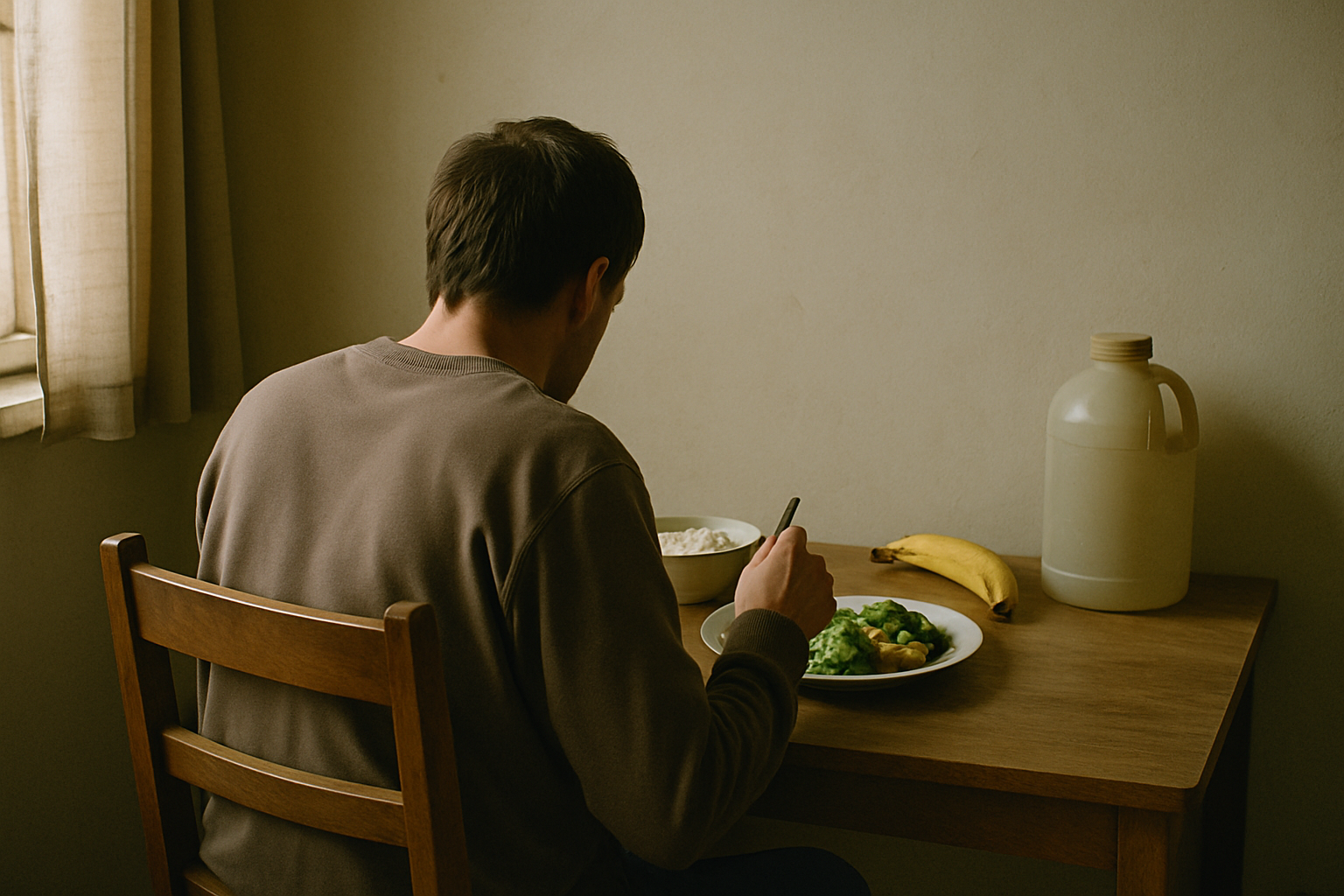
You open the fridge, see half a yogurt, one onion, and a jar of mustard, then close it again because figuring out what to make with that feels harder than skipping the meal. You’re trying to feed yourself while money is tighter than you want, your energy isn’t what it used to be, and even choosing food can feel like one task too many.
Skip ahead:
- The first goal is three reliable meals you can repeat this week
- The £25-to-£40 starter shop that covers most of the week
- Cheap healthy meals and cheap convenient meals both have a place
- Three fallback meals for when the week goes sideways
- Where most meal plans fall apart after a rupture
- A 30-minute reset for your kitchen, even if it is a mess
- The four meal formulas worth repeating this month
- Mornings get easier when breakfast stays the same for five weekdays
- One hour on Sunday or ten minutes each day: choose the version your life will accept
This week’s goal is food that’s cheap, decent, and easy enough to repeat. That’s all.
The first goal is three reliable meals you can repeat this week
Start smaller than your best intentions. Pick three meals total for the next 7 days: one breakfast, one lunch, one dinner. If that feels too repetitive, add one backup meal. Aim for food that’s broadly balanced: something filling, some protein, some fibre, and at least one fruit or vegetable most days. It doesn’t need to look like a wellness ad. It needs to be doable on a tired Tuesday.
This is where a lot of advice falls apart. People try to reset everything at once, buy 18 ingredients for six different recipes, and end up with wilting spinach, a sink full of pans, and takeaway by Thursday. Too many choices create work before you’ve even eaten.
A short repeat list gives your shopping a clear shape.
If you’re starting over after a rupture, your appetite, schedule, and concentration may be all over the place. That’s real. Food routines that ask for enthusiasm usually fail first. A plain bowl of pasta with lentil tomato sauce that you’ll actually make twice is more useful than an ambitious recipe you save for “when things settle down.”
This costs variety, and that can feel dull faster than anyone likes.
The £25-to-£40 starter shop that covers most of the week
The base ingredients that stretch furthest
Prices vary by shop and region, but a basic weekly shop in the £25 to £40 range can go a long way if you build around staples that overlap. A solid base looks like this:
- Oats
- Eggs
- Rice
- Pasta
- Potatoes
- Tinned beans
- Dried or tinned lentils
- Frozen vegetables
- Onions
- Carrots
- Yogurt
- Bread
- Peanut butter
- Tinned tomatoes
- Bananas or apples
Most of these are cheap per serving and can turn into several different meals. Oats can cover breakfast for five days. Potatoes can be baked, microwaved, or chopped onto a tray. Tinned tomatoes can become pasta sauce, soup, or beans in sauce with spices if you already have them.
Protein, fibre, and convenience without overspending
For week one, buy at least one easy protein source and one no-prep item. Eggs and beans are usually the cheapest useful proteins. Tuna can help if it fits your budget. Yogurt earns its place too because it works for breakfast or an almost-no-cook meal.
Your no-prep item might be bread, microwave rice, fruit, or a tub of hummus. Pre-washed greens cost more, so only buy them if they genuinely stop waste. If a whole cabbage will sit untouched but a smaller ready-to-use bag means you’ll actually eat some vegetables, that tradeoff can still make sense.
What not to buy in week one
Skip ingredients that only serve one recipe, fancy sauces you don’t already use, giant packs you probably won’t finish, and “healthy” extras that push the bill up fast. Chia seeds, expensive snack bars, and specialty spreads can wait. Fresh herbs can too unless you already know exactly where they’re going. That trade-off gets a closer look in Healthy Habits When You Are Starting Over at 50.
Where this shop commonly goes wrong
Shopping while hungry tends to raise the bill and lower the usefulness of what comes home. Buying for a fantasy version of your week causes trouble too: the version where you roast vegetables every night, wash every pan right away, and suddenly love cooking from scratch.
Fresh produce is great when it gets eaten. It’s expensive compost when it doesn’t.
The smarter call is usually frozen vegetables over ambitious fresh produce for week one.
Cheap healthy meals and cheap convenient meals both have a place
The best meals for low energy days
These are the meals for nights when 10 minutes feels like plenty:
- Beans on toast with fruit — about 5 minutes with tinned baked beans; add an apple or banana.
- Scrambled eggs with frozen peas on toast — about 7 minutes, all in one pan.
- Microwave potato with beans, about 8 to 10 minutes depending on your microwave; filling and cheap.
- Yogurt with oats and banana, 2 minutes; easy for breakfast or lunch.
The better options when you have 20 minutes
If you’ve got a little more time, make something that leaves you with food for later:
- Lentil pasta sauce: cook onion and carrot if you have them, add tinned tomatoes and lentils, simmer for 15 to 20 minutes, then serve over pasta.
- Fried rice with frozen veg and egg: best with leftover rice; about 15 minutes.
- Tray-bake potatoes and carrots with eggs or beans on the side: about 20 minutes of prep plus oven time; once it’s in, there’s not much to do.
Why convenience is sometimes the smarter choice
A ready option that costs a bit more can still save money if it stops a takeaway order or means you eat instead of skipping a meal and buying snacks later. Microwave rice, tinned soup with bread, and ready-cooked lentils cost more than starting from dry ingredients, but they make it less likely that food becomes one more thing to sort out this week.
Cheap food helps only if you’ll actually eat it. And frankly, the push to cook everything from scratch gets oversold when someone is barely holding the week together.
Three fallback meals for when the week goes sideways
The cupboard meal
Pasta with tomato-bean sauce: boil pasta, warm tinned tomatoes with drained beans, and add salt, pepper, or dried herbs if you have them. About 10 to 12 minutes. Almost everything lives in the cupboard.
The freezer meal
Frozen veg egg rice: cook rice or use microwave rice, heat frozen vegetables in a pan, then scramble in two eggs. About 10 minutes. Hardly any chopping, hardly any washing up.
The “I can’t really cook tonight” meal
Yogurt, oats, banana, and peanut butter on toast. About 3 to 5 minutes. If even that feels like too much, bread with peanut butter plus a banana is enough for tonight.
The threshold for keeping these in the house
Keep ingredients for at least 2 fallback meals at home all the time. Plans usually fail on the hardest day, not the easiest. A backup meal isn’t proof you messed up. It’s part of the plan.
Where most meal plans fall apart after a rupture
A lot of the friction has nothing to do with recipes. Your appetite may change from one day to the next. Eating alone can make cooking feel less worth it. Irregular work hours or job searching can throw off normal meal times. A shared kitchen can make even simple meals tiring if there’s tension at home or barely any fridge space. Money worries add another layer: people stretch food so far they stop buying basics, then end up with nothing quick to eat.
Rigid prep systems often assume a calm Sunday, clear counters, spare containers, and a week that goes to plan. A lot of weeks don’t. Under strain, simpler structure tends to hold up better: repeat meals, fewer ingredients, visible food at eye level, and backup options like beans on toast with fruit or yogurt with oats and banana that take almost no thought. If this period of your life also includes grief or intense distress and daily tasks are getting hard to manage, reaching out to a qualified professional or local support service is a practical step.
A 30-minute reset for your kitchen, even if it is a mess
The 10-minute clear-and-throw-away pass
Set a timer for 10 minutes. Throw away expired food. Clear one shelf. Wash one pan, one bowl, and one mug. Then stop when the timer ends. That usually works better than waiting until you have the energy to overhaul the whole room.
The 10-minute setup that makes meals easier
Put your most useful foods where you can see them: oats on the counter, bread within easy reach, eggs at the front of the fridge, fruit in one visible bowl or bag. Put one pan on the hob and one spoon nearby. Those small visibility changes cut friction because they shrink the pause where dinner turns into a debate.
The 10-minute cook-now step
Use the final 10 minutes to make one thing that helps tonight and tomorrow: boil eggs, cook rice, or make a pot of lentil tomato sauce. Total time is about half an hour. A full kitchen reset often falls apart because it asks for energy before there’s food ready. This version gets rice, eggs, or lentil sauce going first.
The four meal formulas worth repeating this month
Starch + protein + veg + sauce
Rice, pasta, or potatoes, plus beans or eggs, plus frozen vegetables, plus something to bring it together: tomato sauce, yogurt, grated cheese if you already buy it, or just butter and black pepper. This formula works because you can swap rice for pasta, beans for eggs, or tomato sauce for yogurt without having to rethink dinner from scratch. (Related: How to Eat Better With No Savings and No Time)
Toast or bread + protein + produce
Peanut butter and banana. Eggs and tomatoes. Hummus and cucumber. These lunches are quick, use familiar ingredients, and don’t leave you with much washing up.
Bowl meals that use what is left
Start with grains or potatoes, add cooked vegetables or salad bits, add beans or eggs, then finish with something sharp or creamy such as yogurt, mustard, lemon juice if you have it, or pickle brine from a jar. Bowl meals come into their own near the end of the week, when what’s left looks random but is still good to eat.
Soup, stew, or pasta sauce from cheap staples
Tinned tomatoes, lentils, onions, carrots, and beans can turn into several meals with small changes in texture and seasoning. The cost logic is straightforward: overlapping ingredients cut waste. One bag of carrots can go into soup, sauce, tray bakes, and fried rice.
Mornings get easier when breakfast stays the same for five weekdays
Pick one breakfast and repeat it from Monday to Friday. That one choice can steady the rest of your shopping because you’ll know exactly what needs replacing next week and what doesn’t. It also cuts waste: one tub of yogurt gets finished, one loaf of bread gets used, and one bunch of bananas has a clear job.
A few workable examples: oats with banana and peanut butter, about 5 minutes; toast with peanut butter and fruit, about 3 minutes; yogurt with oats and sliced banana, about 2 minutes. They’re all relatively low-cost breakfasts built from ingredients that can show up elsewhere in your week.
This approach falls apart when breakfast asks too much of you or relies on foods you never actually want at 8am. If overnight oats sound efficient but you dislike cold oats, skip them. If eggs mean washing up that puts you off eating before work, save eggs for later in the day. (Burnout Recovery Meals on a Tight Budget has the full walkthrough.)
One hour on Sunday or ten minutes each day: choose the version your life will accept
The one-hour approach
If Sundays are reasonably predictable, use 1 hour to shop or unpack groceries, cook one main dish for two nights, boil eggs, and portion out breakfast items for five days. This suits people who’d rather think once, then coast for a few days.
The ten-minutes-a-day approach
If your schedule is messy or your energy changes day by day, use 10 minutes each day. Give each day one small food task: cook rice today, wash produce tomorrow, make lentil sauce the next day. This often fits better after a major upheaval because it doesn’t assume your future self will have the same capacity as your current self.
How to decide which one fits this month
If unopened groceries often sit there while plans change around them, go with ten minutes a day. If weekday evenings keep ending in hunger and expensive last-minute choices, try the one-hour block. You can switch next week. Recovery rarely moves in a straight line, and food systems should bend with that rather than punish you for it.
Your next action: write down three meals for the next seven days on paper or in your phone notes app before you do anything else. Apple Notes is fine if that’s what you already open without thinking.