
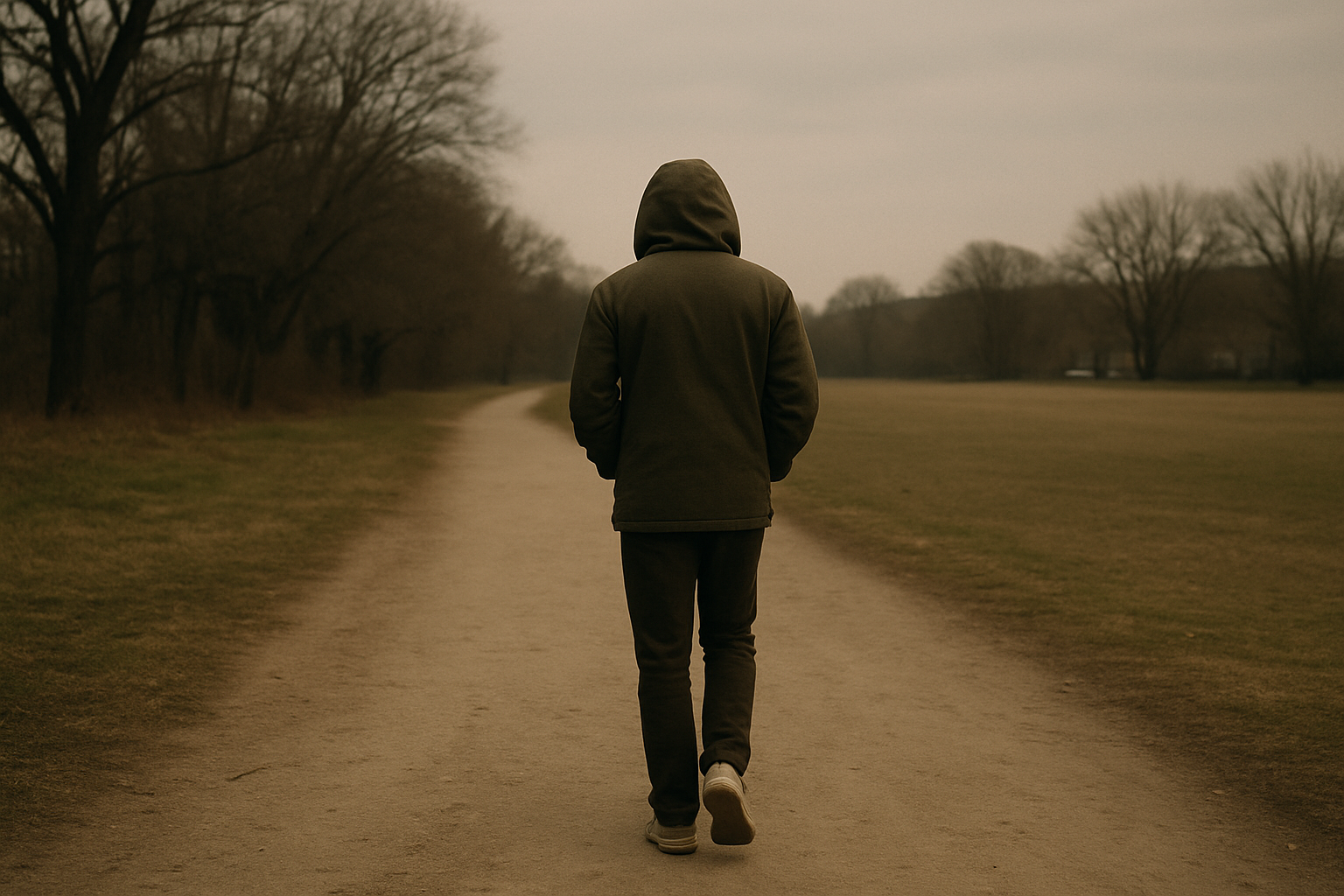
You stand in the kitchen, put the kettle on, and realise you’ve been wearing the same indoor clothes since yesterday. Something big has broken open in your life, and even basic tasks may feel heavier than they should. If you need one action that asks for no membership, no gear, and no big speech to yourself, a short walk can be a modest stabilizer. If you feel unsafe with your thoughts or unable to cope, please reach for real support first: a qualified professional, someone you trust, or local crisis help such as 988 in the US.
In this article
- When life is wrecked, walking is often the least impossible option
- The 10-minute minimum that still counts
- Routes, timing, and friction decide whether the walk happens
- Walking alone and walking with someone each help in different ways
- What this looks like in real life when everything feels unstable
- The hidden cost of turning a walk into self-improvement
- If walking brings up grief, panic, or the sense that you're not okay
When life is wrecked, walking is often the least impossible option
Walking fits a low-capacity week because it asks for almost nothing. You can do it in ordinary clothes, stay close to home, and stop after five minutes. You don’t need to figure out a program, choose the right class, or wait until motivation shows up. That helps when your mind is crowded, your time is chopped up, or you’re simply trying to get through the day without making things harder.
A short walk can give the day a little structure. It changes the view in front of you for a few minutes. It gives you one finished action when other parts of life feel slippery or unfinished. There’s a practical example of this in Grief, Burnout, and the Fog of Starting Over.
None of that makes it magical. Some days it’ll feel annoying, pointless, boring, or physically out of reach. Some days you may get outside and want to turn back almost at once. That doesn’t mean you’re doing recovery wrong. It means this is a hard season.
The 10-minute minimum that still counts
A floor, not a fantasy target
Use this threshold for this week: 10 minutes, once a day, on 4 days this week. That’s the whole plan.
Ten minutes counts if it’s slow. It counts if you pause at the corner. It counts if it’s one block out and one block back. Time cost: about 10 minutes, plus putting on shoes and getting out the door. If you already know the federal guideline of 150 minutes a week from the CDC, set it aside for now.
Bigger targets have their place. This week needs something you can do. And honestly, the popular urge to turn every walk into a fitness milestone misses the point here. Healthy Habits When Your Life Just Blew Up tackles the same question from the other direction.
What to do on day one
Put your shoes by the door tonight.
Tomorrow, walk for 5 minutes away from home and 5 minutes back. Use your phone timer if that helps. If 10 minutes feels too high, make it 6 total minutes and keep the same out-and-back shape: 3 minutes away, 3 minutes back. That shape removes one decision. You don’t have to pick a destination.
Where this commonly fails
A lot of people quietly apply a “real exercise” standard and then skip the walk because it seems too small to count. After a rupture, all-or-nothing thinking can attach itself to routines fast. If the walk can’t be impressive, it gets dismissed.
What counts as enough right now?
Use a simpler standard: success means you showed up. No pace target. No distance target. No demand to feel better by minute eight.
Routes, timing, and friction decide whether the walk happens
The route should be boring enough to repeat
Pick one route under 12 minutes round trip and one route around 20 minutes. Keep both close to home if possible. Prioritize safety, easy crossings, lighting, and a path you don’t need transport to reach. Cost: free if you can start from your door.
If you need to drive somewhere or take a bus just to begin, the route is probably too complicated for this season. Save scenic ambitions for later. The better recommendation is almost always the dull loop you can repeat without negotiation.
The best time is the time with the fewest decisions
Choose one anchor that already exists: right after coffee, after school drop-off, after lunch, or before the evening meal. A walk attached to something that already happens asks less of you than one floating in empty space.
It sounds small because it is small. Small helps.
Weather, fatigue, and bad timing
Build a salvage version before you need one. Make it one lap of the building, the end of the street and back, or 5 minutes indoors in a hallway, stairwell landing, covered area, or even a large store if that’s what’s available to you.
This plan can unravel when people scrap it over less-than-ideal conditions: drizzle, low energy, running late, the wrong coat. Weather usually isn’t the whole problem. The problem is that the plan only worked on ideal days. A backup version keeps one rough day from turning into “I’ve stopped.”
Walking alone and walking with someone each help in different ways
Solo walks can lower pressure
If you don’t want to talk, explain yourself, or manage someone else’s reaction, go alone once this week. Keep your phone on silent unless you need it for safety. Give yourself 10 or 15 minutes when nobody gets access to your face or your voice.
This can help most when you feel overstimulated or worn out from answering questions.
Shared walks can add accountability without turning into “catching up”
If being alone makes it easier to cancel, ask one person directly: “Can you walk with me for 15 minutes this week? I don’t need advice. I just need company.”
Time cost: about 15 to 20 minutes. Money cost: free.
The right person is someone who can keep it simple for 15 minutes. That may not be your closest friend. It might be a sibling who doesn’t pry, a neighbor who already walks after dinner, or a coworker who’ll meet you at lunch and keep moving.
Where company backfires
A shared walk can get draining fast if the other person minimizes what happened, pushes solutions, talks over you, or turns 15 minutes into a full emotional postmortem. Then the walk becomes one more demand. (Healthy Habits When You Are Starting Over at 50 has the full walkthrough.)
You’re allowed to keep it practical and brief. You’re allowed to choose company based on steadiness rather than closeness.
What this looks like in real life when everything feels unstable
Some walks will be slow and distracted. Some will be tearful. Some will be numb. Some will be full of admin lists: call the lawyer, email HR, check the insurance form, pick up bread, text my sister back.
Some will feel almost insultingly ordinary when your life feels anything but ordinary. That doesn’t cancel out their usefulness.
You don’t need a peaceful route or an uplifting mindset for the walk to be worth doing. You don’t need insight by the end. You don’t need to come home changed.
A short walk can still do its job when you spend half of it staring at cracked pavement and thinking about logistics. In an unstable stretch, one solid edge in the day can be enough.
The hidden cost of turning a walk into self-improvement
Tracking can help if it stays small
For one week, track only one thing: did you walk today, yes or no. If you want a second line, add minutes walked rounded to 5-minute blocks.
Use whatever is easiest: paper on the fridge, Apple Notes, or tick marks in your phone calendar. Cost: free.
Skip the upgrades for now
You don’t need step goals, watch comparisons, expensive shoes, productivity podcasts, habit journals, or a new stacked routine built around hydration and sunrise exposure. Extra layers can quietly raise the bar until leaving the house feels like managing a project.
If your shoes are comfortable enough and safe enough for a short route, they’re probably good enough this week.
Where many healthy-habit plans collapse
People try to make one small routine carry everything at once: healing, productivity, body image, social life, identity, discipline. That’s too much weight.
Keep this light enough that missing one day doesn’t become a verdict on the whole week. Four days out of seven still counts as following the plan you set.
If walking brings up grief, panic, or the sense that you’re not okay
Sometimes a quiet walk gives hard thoughts more room to surface. Once you’re outside without screens or tasks in front of you, grief may rush in. You might feel shaky, overwhelmed, scared by your own thoughts, or suddenly aware that you’re coping less well than you hoped. Take that seriously and reach out to an actual person, instead of trying to push through alone because an article said walking could help.
If you need immediate support in the US, the 988 Suicide & Crisis Lifeline is available 24/7 by phone or text at 988, or by chat at 988lifeline.org. Crisis Text Line is also available 24/7: text HOME to 741741. If what’s coming up feels ongoing rather than immediate, a qualified mental health professional is a better next step than trying to manage it with longer walks or stricter routines. If cost is part of what stops you from getting care, HRSA-funded community health centers offer services on a sliding fee scale based on your ability to pay; you can look for one at findahealthcenter.hrsa.gov. If you want treatment referrals in the US, SAMHSA’s National Helpline is 1-800-662-HELP (4357), free and confidential, 24/7.
Your next action: put your shoes by the door tonight and set a 10-minute timer for tomorrow’s out-and-back walk.